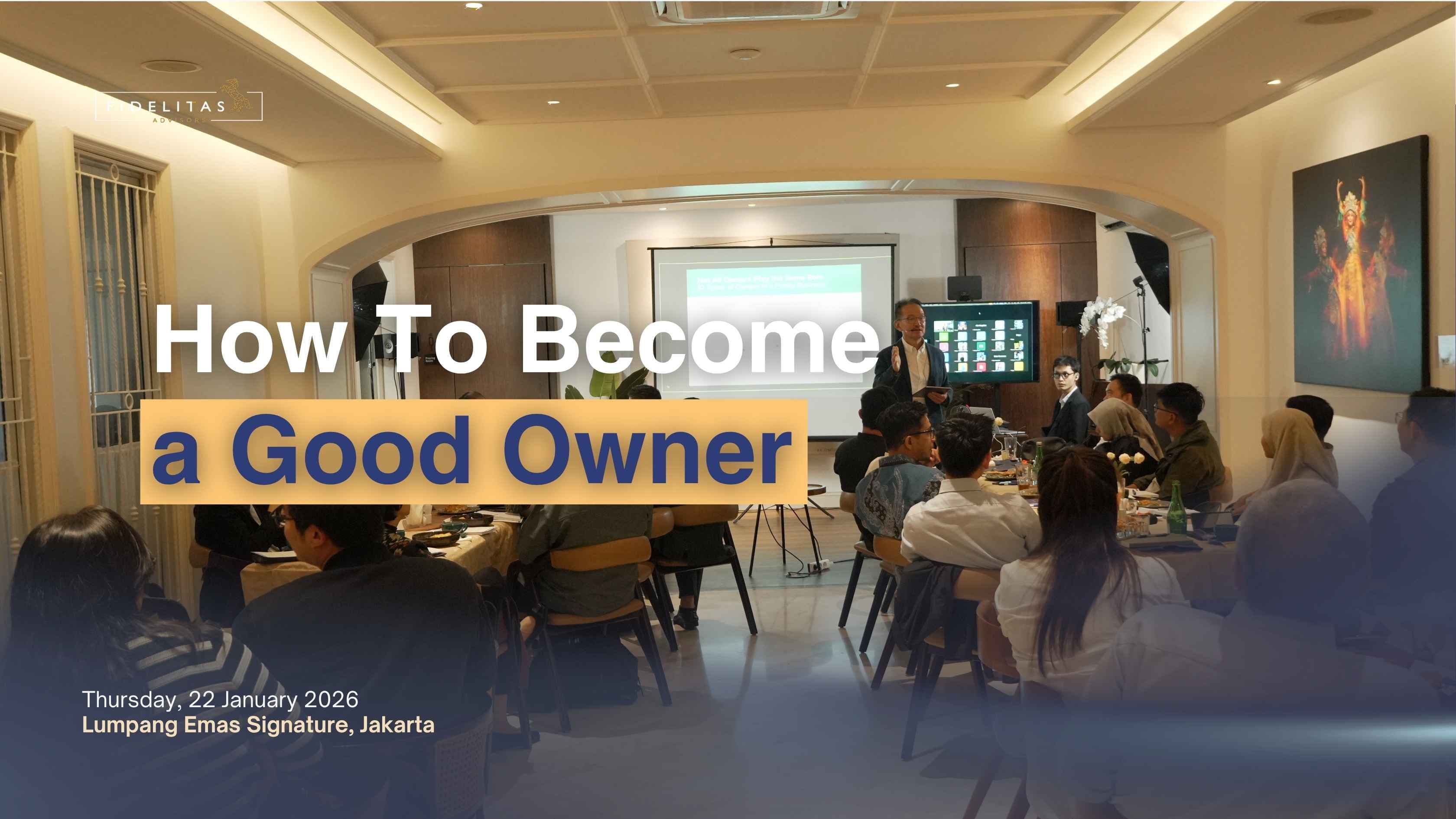
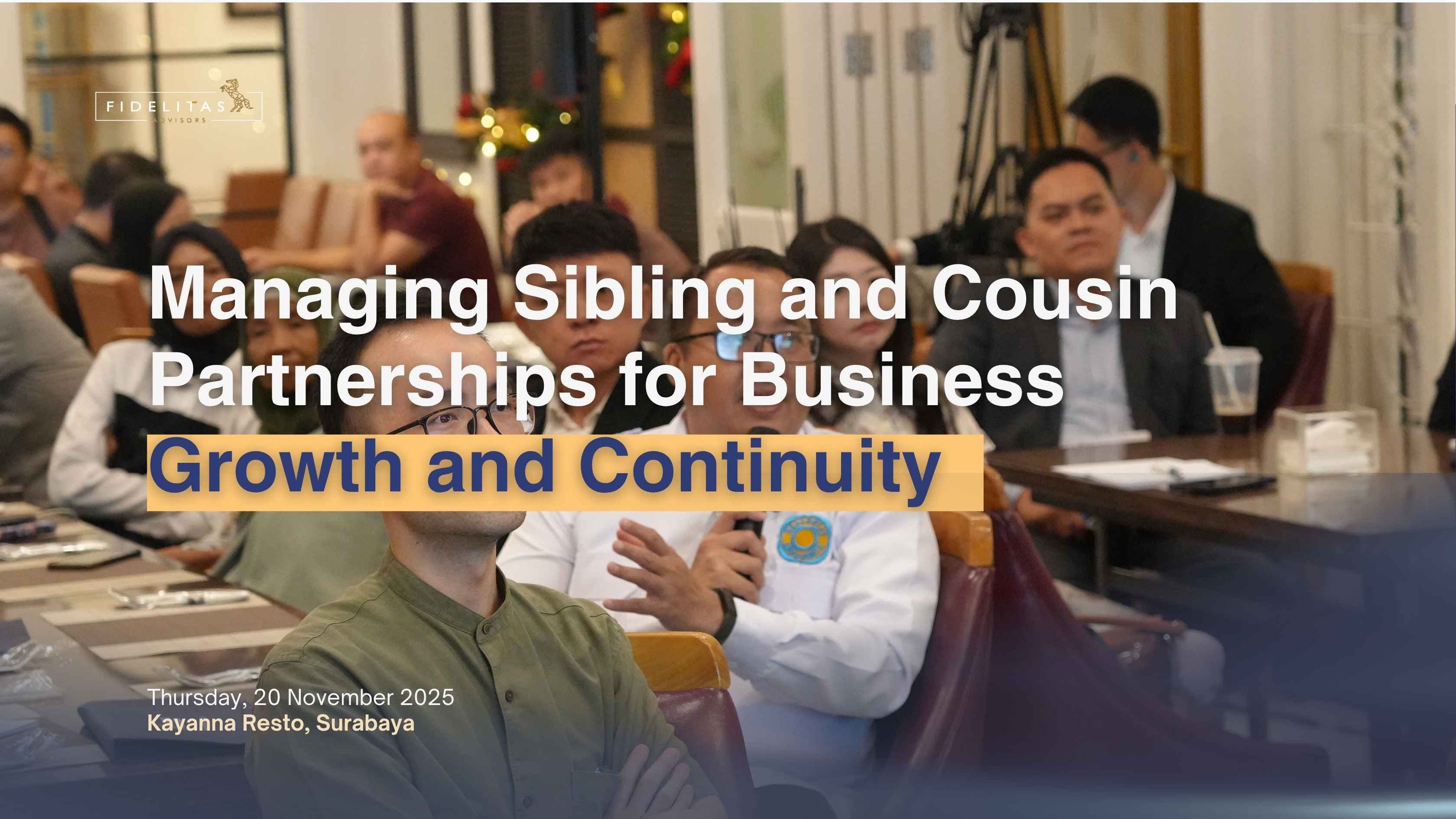
The interactive talk show “Who Am I in This Business?”—hosted both in person and online by Fidelitas Advisors—brings together founders, the next generation, owners, and board members in a shared space for reflection.
In family businesses, questions about roles often seem simple, but their impact is profound. When roles aren’t clearly defined, decision-making becomes unclear, boundaries of authority are blurred, and family relationships gradually bear an invisible burden.
This session did not begin with theory, but rather with case studies illustrating the dynamics that frequently occur in many family businesses. Participants are invited to identify patterns before engaging in a discussion with the speakers. This approach helps separate structural issues from personal dynamics, ensuring that the discussion moves beyond mere opinions toward a systemic understanding.
A Founder’s Perspective on Defining Roles

In a continuously growing business, the boundaries of authority become crucial. Founders can no longer rely solely on personal intuition. As the next generation becomes involved, role structures must be consciously designed to avoid ambiguity down the line.
This discussion demonstrates that role clarity is not a form of restriction, but rather a form of protection. It shields the founder from an excessive decision-making burden while protecting the next generation from unspoken expectations.
The Next Generation’s Dilemma: Between Being a Child, a Professional, and a Potential Successor
One of the main focuses of this session was the dynamics faced by the next generation. They not only fulfill professional roles but also carry the identities of children and potential successors.
When family expectations and professional demands are out of alignment, confusion arises—a topic rarely discussed openly. The discussion emphasized that the next generation’s credibility cannot be built solely through family status. It must be built through competence, a proven track record, and a clear mandate.
Without a clearly defined role, the next generation risks being trapped in an ambiguous position—either too close to decision-making without formal authority, or, conversely, holding a formal position without a clear sphere of influence.
Role Clarity as the Foundation for Growth

- Objectively define the boundaries of authority
- Reduce conflicts arising from overlapping roles
- Strengthen the legitimacy of decisions
- Ensure continuity across generations
The discussion underscores that the growth of a family business depends not only on market strategy but also on sound internal design. When the role structure is well-defined, family relationships do not have to bear the burden of operational decisions.
Risks When Roles Are Undefined
Role ambiguity often isn’t immediately apparent as a problem. However, in the long term, it creates significant risks. Decision-making slows down because it’s unclear who has the final say. Personal conflicts arise due to differing expectations. The organization loses direction because the authority structure isn’t well-defined.
In the context of business continuity, role clarity is not merely a relational issue. It is a risk management issue. While the founder is still active, ambiguity may be masked by a central figure. However, when generational transition occurs, a fragile structure will become immediately apparent.
The Impact of Role Clarity on Family Businesses

Family businesses that consciously design intergenerational roles will be better prepared to face leadership transitions, increasingly complex organizational growth, and shifting ownership dynamics. Clear mandates help distinguish the roles of owner, manager, and supervisor, so that decisions no longer depend on individual figures but on the structure itself.
On the relational front, role clarity reduces the room for assumptions that often become a source of tension. When expectations are discussed and agreed upon, family relationships do not have to bear the burden that should rightfully fall on the system.
Ultimately, role clarity is not merely about who does what. It’s about ensuring every position has a legitimate basis and every decision has a clear direction.
And perhaps, before a family business discusses expansion or succession, a more fundamental question still needs to be answered first: does everyone truly understand their role today?