Some family businesses feel that their foundation is already strong, the founder is still active, the business is doing well, and family relationships are harmonious. However, today’s strength does not guarantee readiness to face an unexpected event. When leadership transition isn’t planned well in advance, a sudden event can turn a strong business into a family crisis.
This issue is the focus of “Succession Planning Starts Long Before You Step Down,” a session presented by Fidelitas Advisors. Through three case studies, a presentation, and a Q&A session, participants were encouraged to view succession planning not as a decision that can be postponed, but as a process that must begin long before the current generation’s leadership term ends.
Three Case Studies: Risks That Are Often Overlooked

The session opened with a 20-minute Group Case Analysis, during which participants were divided into groups to discuss three case studies, each representing a different type of risk in the succession process.
The first case, “Business Continuity Risk,” tells the story of a 68-year-old founder who remains at the center of nearly all the company’s critical decisions—from relationships with key customers, banks, and suppliers to investment decisions. His children were already working at the company, but there had never been a clear discussion about who would lead or make strategic decisions if something were to happen to the founder. When the founder suffered a heart attack and died suddenly, the company lost its sole decision-maker without a ready successor.
The second case, “Leadership Transition Risk,” describes a situation that, on paper, appears to be well-managed. The founder appointed his son as Chief Operating Officer several years ago, and the next generation already holds key positions within the company’s structure. In practice, however, nearly all major decisions still require the founder’s approval. Senior employees, key customers, and even other family members still feel more comfortable communicating directly with the founder. When the founder begins to step back, the organization becomes confused about who is actually in charge.
The third case, Family Alignment Risk, highlights the dynamics among four siblings with four different paths: one wants to lead the family business, one wants to work at the company without becoming CEO, one has chosen a career outside the family business, and the other is not interested in working in the family business but still hopes to reap benefits as a shareholder. Until now, the family has rarely discussed openly matters such as stock ownership, dividend distribution, terms of employment within the company, or each member’s future role, as the founder felt these discussions could be postponed as long as family relations remained harmonious.
These three cases show a common pattern: succession risks rarely stem from open conflicts, but rather from issues that have been left unaddressed for too long.
Why Succession Often Fails
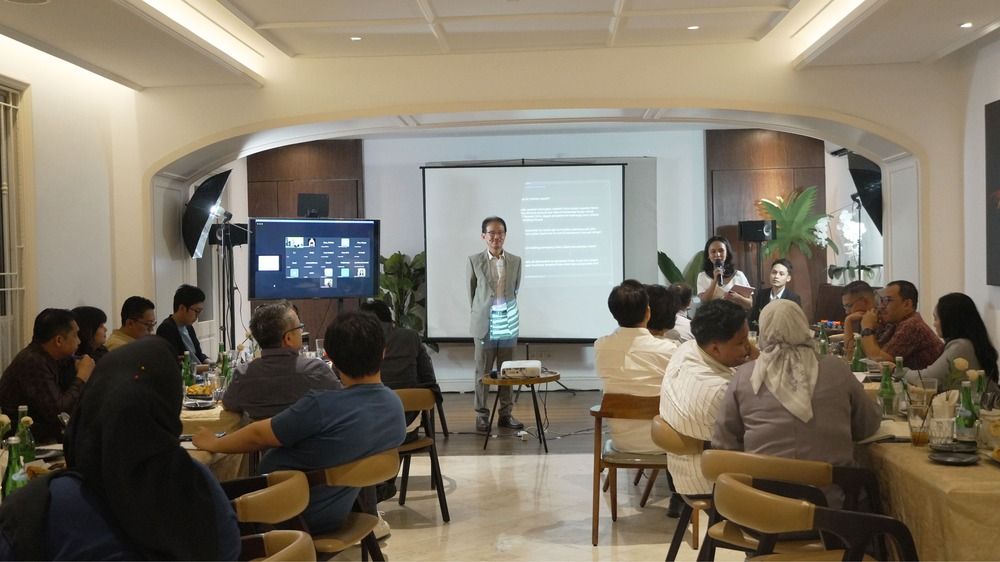
The presentation was delivered by David Bingei, M.Sc-LBS, CF-ICAEW, a Principal at Fidelitas who is also a former Board Member of a Fortune 500 company.
The presentation began by defining succession planning as the process of transitioning leadership and ownership of a family business from one generation to the next, and emphasized that the success of this transition should be the most important legacy left by the founder or head of the family. There are three main challenges that make it difficult to ensure the sustainability of a family business. First, an unclear governance structure; the absence of family consensus on fundamental issues such as compensation and remuneration, roles and responsibilities, the boundaries between personal, family, and business matters; and the question of fairness versus equality in ownership and the distribution of shares. **Second, reliance on one or two individuals—**which, according to David, often occurs due to a lack of awareness or reluctance to prepare a successor—even though, biologically speaking, a generation typically spans 30–40 years, meaning a business that has been operating for that duration should already have begun implementing succession planning. Third, disputes, which he says are easy to understand logically but difficult to resolve emotionally.
Challenges for the Next Generation and Stages of Ownership
In addition to challenges from the founder’s perspective, there are also issues frequently faced by the next generation, ranging from uncertainty about whether to join the family business or not, to the conflict between a sense of entitlement and tangible contributions, conflicting choices and challenges, conditions for joining, qualifications, self-confidence, building a personal identity separate from the family name, training and development needs, a potential lack of interest or talent in the field, and establishing credibility in the eyes of non-family employees.
David also maps out succession issues based on the stages of family business ownership.
- In Stage 1 (The Founder), the main issues revolve around leadership transition, succession, and estate planning.
- In Stage 2 (The Sibling Partnership), the focus shifts to maintaining cooperation and harmony among siblings, preserving family ownership, and the next phase of succession.
- Meanwhile, in Stage 3 (The Cousin Confederation), the issues become more complex, encompassing the allocation of corporate capital (dividends, debt, and profit margins), shareholder liquidity, resolution of family conflicts, family participation and roles, the family’s vision and mission, and the family’s connection to the business.
Four Succession Paths: Which One to Choose?
- The first path, “Founder Doesn’t Prepare, Next Gen Doesn’t Know”: there is no succession plan; the next generation views the business as irrelevant to them; and the business ends with the first generation.
- Path Two: Founder Prepares, Next Gen Refuses—the founder has made preparations, but the children choose different career paths, resulting in a lack of leadership continuity and the business eventually declining or being sold.
- Path Three: Founder & Next Gen Committed—both parties are equally committed and share aligned values, but without a clear roadmap, so the business may survive into the second generation but remains vulnerable without adequate institutionalization.
- The fourth path, which David refers to as “Champion Families”: both parties are committed to structured planning, applying the principles of stewardship and the LOGIC framework from Fidelitas, thereby ensuring the business’s sustainability through the third and fourth generations.
Implications for Family Businesses
This session underscored a truth often realized too late: succession planning is not a decision that can be postponed until “the right time,” because the “right time” often only becomes clear after a crisis has already occurred. Statistics presented—showing a success rate of 30% for the transition from the first to the second generation, dropping to just 4% by the fourth generation—indicate that succession failure is not an exception but a common pattern without adequate governance and preparedness.
For family businesses, a realistic first step is to begin reassessing three key areas: the clarity of the governance structure governing compensation, roles, boundaries between personal, family, and business spheres, and equity in ownership; the extent to which the organization relies on one or two key individuals; and creating a safe space to discuss emotionally challenging topics, such as the distribution of shares and the roles of the next generation, before these issues are forced to the forefront during a crisis. As emphasized in this session, successful succession is not just about who will lead, but about whether the family and the business are both ready to face that change together.