“How do I know if the company is really doing well?”
For many family business owners, the answer seems simple: healthy financial statements, targets met, and operations running smoothly.
However, good numbers don’t necessarily mean the organization is in good shape. Problems with inventory, quality, shipping, customers, or decision-making can develop long before their impact is visible in the financial statements.
In the workshop “Internal Control for Family Businesses: From Founder Dependence to Institutional Strength,” one key message emerged: a company isn’t truly under control if all controls still depend on the founder.
When Controls Are Informal

The workshop highlighted three common scenarios in family businesses.
The first case involves an owner who only comes to the office once or twice a month. He feels he knows enough about the company’s condition through conversations over dinner with family members who work in the business. However, when growth began to slow, it turned out the company lacked a monitoring system capable of identifying problems early on.
The second case involves a founder who has asked management to make more decisions but still frequently intervenes and changes decisions regarding purchasing, production, or sales. Management eventually chooses to wait because their decisions can change at any time depending on the founder’s decisions.
The third case involves a company with steadily growing profits, but one that began experiencing inventory issues, shipping delays, machine breakdowns, and customer loss. Since its financial reports still looked good, these problems were not immediately taken seriously.
These three cases illustrate one thing: financial statements can explain what has already happened, but they do not necessarily reveal what is starting to go wrong.
Internal Control Is Not Just a Financial Matter

Warry Sumitro emphasizes that internal control is part of corporate governance, not merely the responsibility of the finance department. Corporate governance sets the direction, authority, and accountability. Internal control ensures that everything is properly implemented in day-to-day operations.
A sound control system requires a division of responsibilities, segregation of duties, approval limits, transaction documentation, supporting evidence, and consistent monitoring. The goal is not to increase bureaucracy. The goal is to ensure that everyone understands who makes decisions, who carries them out, and who oversees them.
Internal Control Must Function Before, During, and After Problems Occur
Internal control operates through three layers.
- Preventive control: prevents problems before they occur through policies, segregation of duties, and clear approval workflows.
- Detective controls: identifying irregularities early through monitoring, supervision, operational reports, and internal audits.
- Corrective controls: address the root cause of the problem and ensure the same issue does not recur.
All three must work together. A good system not only prevents errors but is also capable of detecting and correcting them quickly.
When the Founder Becomes the System
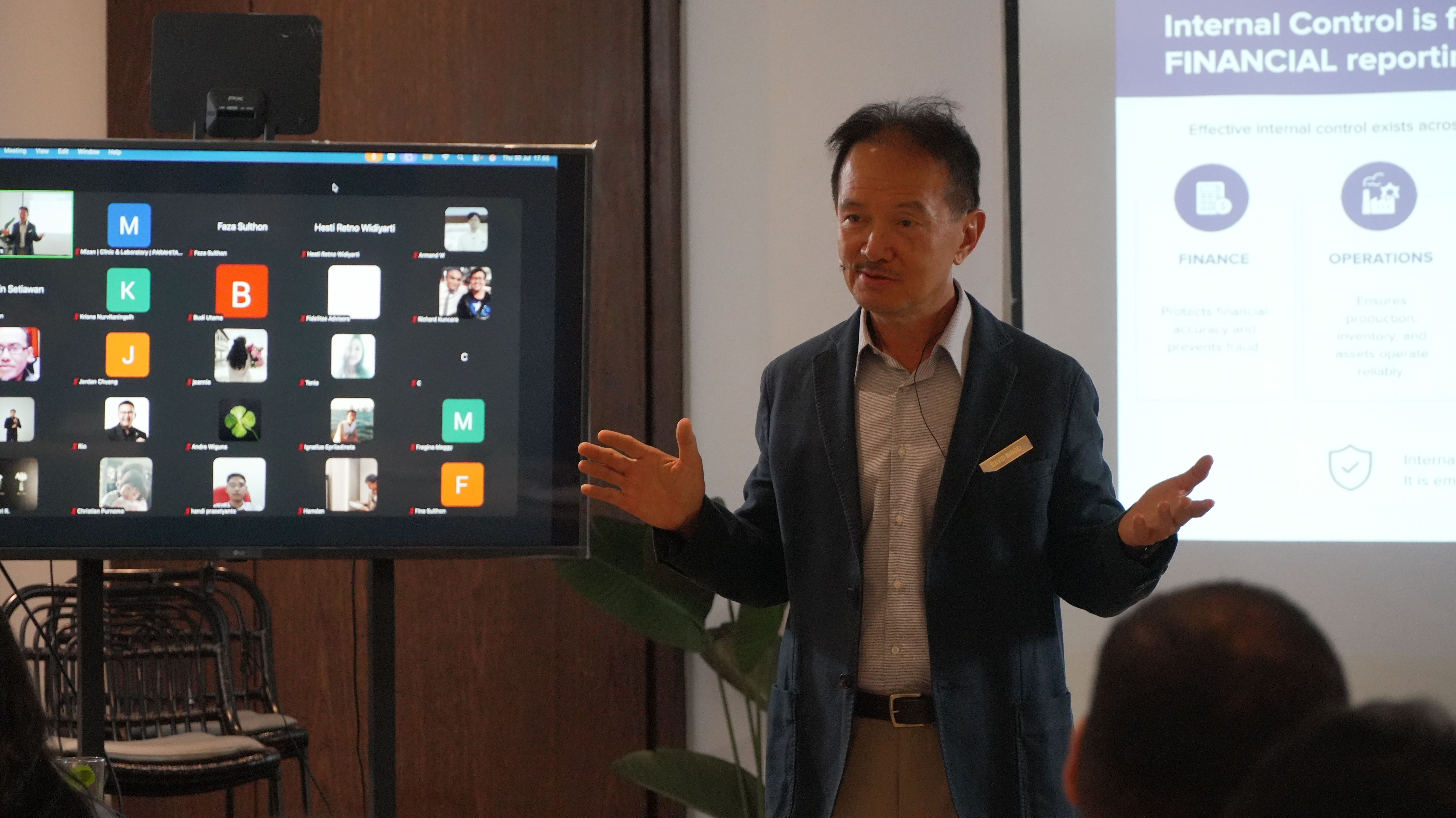
David Bingei, Principal at Fidelitas Advisors, explains four forms of dependency that often arise in family businesses.
- Decision dependency occurs when important decisions are always left up to the founder.
- Knowledge dependency: occurs when critical information about the business, customers, suppliers, and processes is stored only in the founder’s mind.
- Relationship dependency: arises when customers, suppliers, and key employees trust the founder more than they trust the organization.
- Approval dependency: occurs when routine decisions still require the founder’s approval.
When all decisions, knowledge, relationships, and approvals depend on a single person, the founder may appear very powerful. However, the organization actually becomes vulnerable.
The problem becomes even greater when the founder calls for autonomous management but still frequently overturns their decisions. Management eventually learns that waiting is safer than taking responsibility.
The change needed is a shift from “I have to take care of everything” to “I have to build a system that can run without me.”
Building an Objective Control System
In a healthy organization, control responsibilities do not rest with a single person. The operational team executes processes and manages day-to-day risks. The finance, risk, and compliance functions ensure policies are consistently enforced. Internal audit provides the board with an independent assessment of the control system’s effectiveness. The board provides direction and oversight. Management is responsible for execution. Internal audit provides independent assurance.
In many family businesses, all of these functions are still carried out by the founder. The founder serves as the owner, supervisor, decision-maker, and the very person who assesses whether their own decisions are correct. Under these circumstances, it is difficult for controls to function objectively.
Internal Control Is Not Just About Finance
Internal control must encompass the entire organization, ranging from finance, operations, procurement, sales, and marketing to human resources. If the owner only looks at financial statements, operational problems will only become apparent after they affect revenue or profit. Therefore, the company also needs to monitor inventory accuracy, product quality, delivery timeliness, customer complaints, productivity, and machine breakdowns.
Good numbers can mask weak controls.
From Dependence to Institutionalization
The transition toward a stronger organization requires five things. First, the founder’s willingness to reduce the company’s dependence on him or her. Second, a governance structure that clarifies the authority of the board, management, committees, and internal audit. Third, documentation of processes, policies, and limits of authority. Fourth, monitoring of financial and operational indicators. Fifth, a culture that values not only results but also proper processes.
These changes do not happen overnight. However, every authority that is clarified, every process that is documented, and every indicator that is monitored will help the company become more self-reliant.
Control Is an Investment
Internal controls are not established because owners do not trust others. Internal controls are established so that trust has a clear foundation. For companies that still rely on information from informal conversations, start with the most critical processes. Clarify authority, document processes, and establish indicators capable of providing early warnings.
Ultimately, a sustainable family business requires more than just a strong founder. It requires a system that continues to function even when the founder is no longer involved in every decision.