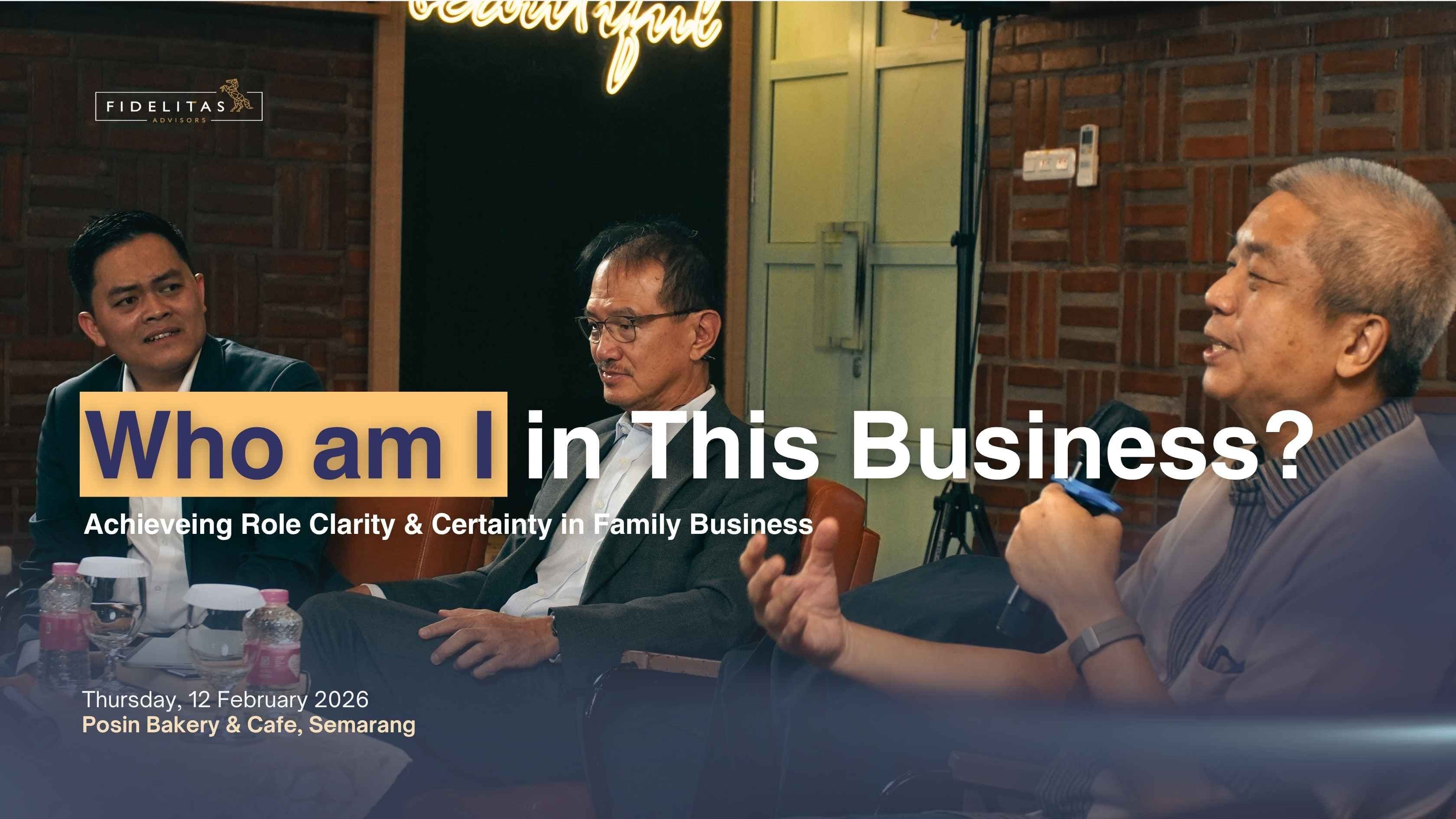
The issue of leadership succession in the continuity of family businesses is almost always a crucial point. Transition is often understood as a change in leadership roles, yet in practice it touches on far more fundamental aspects, including intergenerational trust, family identity, and the business’s long-term direction. At this stage, the family’s readiness is often the primary determinant of a successful transition, even when the business is in good operational condition.
In the “Family Business Succession” discussion on September 25, 2025, Fidelitas explored how the family’s readiness is often the determining factor in a successful transition, even when the business is operating in a healthy state.
Transition as a Critical Point in the Family Business Cycle
One of the most consistent patterns in family businesses is the low success rate of cross-generational succession. Only a small fraction of family businesses survive into the second generation, and even fewer continue into the third. This pattern does not merely reflect a weakness in the business model, but rather the family’s failure to prepare for the transition process in a deliberate and structured manner.
In many cases, the urgency of succession is only recognized when tensions begin to arise. In reality, leadership transition should ideally be treated as a long-term process planned well in advance, not as an emergency response when the founder begins to tire or conflicts have already escalated.
Differences in Perspective Between the Founder and the Next Generation
Leadership succession almost always brings together two different perspectives. From the founder’s perspective, the transition often involves efforts to preserve their legacy and the difficulty of truly letting go of control. On the other hand, the next generation faces the demand to assume a leadership role while still respecting the values and journey that have been built up to that point.
When these differing perspectives are not addressed through open and structured dialogue, the transition process can easily become mired in a tug-of-war over expectations that have never been explicitly stated.
Family Dynamics Add to the Complexity of the Transition
The succession process rarely takes place in a neutral environment. Existing family dynamics tend to influence the course of the transition. Common patterns include sibling rivalry, debates over gender roles, differences in treatment between family members who are active in the business and those outside of operations, and differing perspectives on ownership and the responsibilities of ownership.
In some cases, the next generation may even show resistance or choose not to get involved in the family business. This situation is not an exception but a common consequence when structures and expectations have not been clearly defined.
Succession Demands More Than Just a Change in Position
A sustainable leadership transition demands more than just a transfer of positions or ownership stakes. What needs to be transferred includes the ownership mindset, family values, work ethics, and the decision-making principles that form the foundation of the business.
The sustainability of a family business is largely determined by the extent to which the next generation understands the meaning of ownership—not merely enjoying its benefits. Without this foundation, the resulting leadership may be structurally sound but fragile in terms of values.
Reflections on Family Businesses
 Succession is not a one-time event, but a process that simultaneously touches on business, family, and individual aspects. The family’s readiness to engage in dialogue, build structures, and agree on expectations early on is a key factor in reducing the risk of future conflicts.
Family businesses that consciously prepare for the transition tend to be better able to maintain business continuity while nurturing intergenerational relationships. In this context, succession is no longer viewed as a threat but rather as an integral part of the long-term sustainability of the family business.