Past Event
Family Businesses, Holding Companies, and the Evolution of Control: Preserving Prosperity and Continuity Across Generations
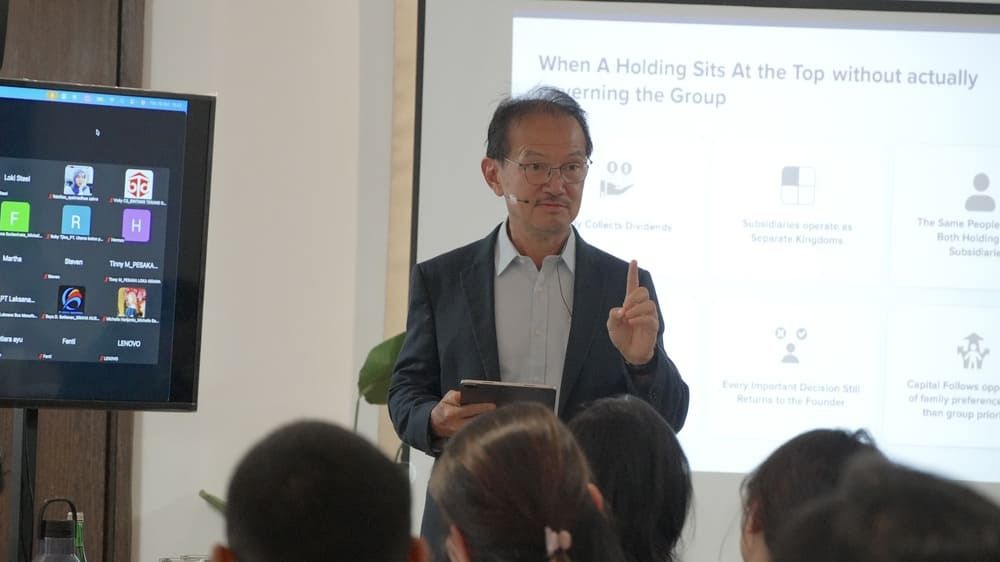
When a family business consists of just one company, the founder can often oversee nearly the entire business directly. Important decisions can be discussed in a single room, supervision is handled personally, and when problems arise, everyone knows who to turn to.
But what happens when one business grows into three, five, or even dozens of companies?
The larger a family enterprise becomes, the more difficult it is for a single person to oversee and control everything. The number of family members increases, ownership becomes more dispersed, capital needs rise, and decisions no longer concern just one company.
In the workshop Family Business, Holding, and the Evolution of Control: Preserving Prosperity and Continuity Across Generations, Fidelitas Advisors invites participants to view a holding company as more than just an ownership structure.
Case Study: When One Family Owns Many Businesses

At the beginning of the session, Fidelitas presented three cases that immersed participants in situations closely resembling the realities of a family business.
- Case 1: One Family, Three Businesses
- Case 2: Leading at Two Levels
- Case 3: After the Holding Company Is Established
These three situations led to one key insight: Having a holding company does not automatically mean a group has effective governance.
A holding company may sit at the top of the organizational structure, but subsidiaries may still operate as if they were independent kingdoms. The same person may manage both the holding company and the operating companies. Important decisions still ultimately rest with the founder. Even investment decisions may be influenced more by family preferences than by the group’s priorities.
When Does a Family Business Need a Holding Company?
Not every family business needs to immediately establish a holding company. As a family enterprise grows, the first thing that needs to be clarified is how ownership will be managed.
Some signs that complexity is increasing include a growing number of businesses, more family members becoming shareholders, greater capital needs, intergenerational leadership transitions, and increasing needs for governance and board oversight.
Therefore, the question is not just “Do we need a holding company?”, but “What role should the holding company play for our family and our group?”
The existence of a holding company does not necessarily ensure that all companies move in the same direction. Its effectiveness depends on the clarity of its mandate, the division of authority, accountability, and the family’s ability to manage and oversee the businesses as a single group.
A Holding Company Provides Structure. Governance Makes Control Work.
One of the main topics discussed in the session was the difference between having a holding company structure and having effective holding company governance.
Organizational structure alone does not address who is authorized to make decisions, which decisions remain with the subsidiaries, when the holding company needs to get involved, and which issues must be escalated.
The workshop material emphasized four key points. The Holding’s mandate must be clearly defined. Decision rights must be articulated through a structured framework of authority. Oversight cannot rely solely on financial reports, as problems may only come to light when it is already too late. And most importantly, family control must evolve beyond reliance on specific individuals.
This evolution of control is at the heart of the workshop’s discussion: from personal control to institutional control. The founder continues to play a vital role. However, control no longer means the founder must be involved in every decision. More mature control means the family is able to ensure that direction, limits of authority, accountability, and oversight mechanisms continue to function, even when the founder is not in the room.
Holding and Operating Companies Have Different Roles
When the Holding Company begins to function as a governance layer, the family needs to distinguish its role from that of the operating company.
At the Holding Company level, the focus is on the Group’s long-term direction. This includes preserving the family’s vision and continuity, determining investment and diversification strategies, and overseeing the boards of the companies under its umbrella.
Meanwhile, the operating company focuses on business execution, profitability, growth, innovation, achieving KPIs, and reporting performance to the holding company as the shareholder.
Without this separation, the holding company risks becoming an additional layer without any truly distinct functions.
What Makes a Holding Company Effective?
The size of the holding company’s organization is not the primary determinant.
During the workshop, Fidelitas introduced the Five Foundations of an Effective Holding Company:
- Clear Mandate
Why does the Holding Company exist, and where does it need to create value? - Clear Authority
Which decisions rest with the Holding Company, and which remain the responsibility of the subsidiaries? - Clear Accountability
Who holds subsidiary management accountable for its performance? - People with the Right Capabilities
Do the people at the holding company level have the ability to think across the Group? - Capital Discipline
How does the Group evaluate investments, acquisitions, new businesses, and diversification?
These five foundations bring the discussion of the Holding Company back to an issue far more fundamental than legal structure:
How does a family intend to steer, oversee, and safeguard its businesses as a single Group?
From Founder-Driven to Institutionally Governed
Ultimately, establishing a holding company is not merely about placing several companies under one roof.
One roof does not necessarily mean one direction.
A family enterprise may have a Holding structure that looks neat on paper, but still rely on the founder for nearly all major decisions.
Conversely, an effective Holding structure helps the family maintain control without having to directly manage every activity.
As the business grows and generations change, the form of control must evolve as well. Decisions that once rested solely with the founder become clear mandates. Personal oversight gives way to formal oversight mechanisms. Informally understood authority transforms into agreed-upon decision rights.
The goal is not to reduce the family’s control. The goal is to ensure that control remains effective as the business grows and the family moves into the next generation. Therefore, for families that already have a holding company, the question may no longer be:
“Is our holding company structure correct?”
But rather:
“If the founder is no longer involved in every decision, will our holding company still be able to maintain the Group’s direction and control?”